Difficulty: Beginner. Categories: Mathematics.
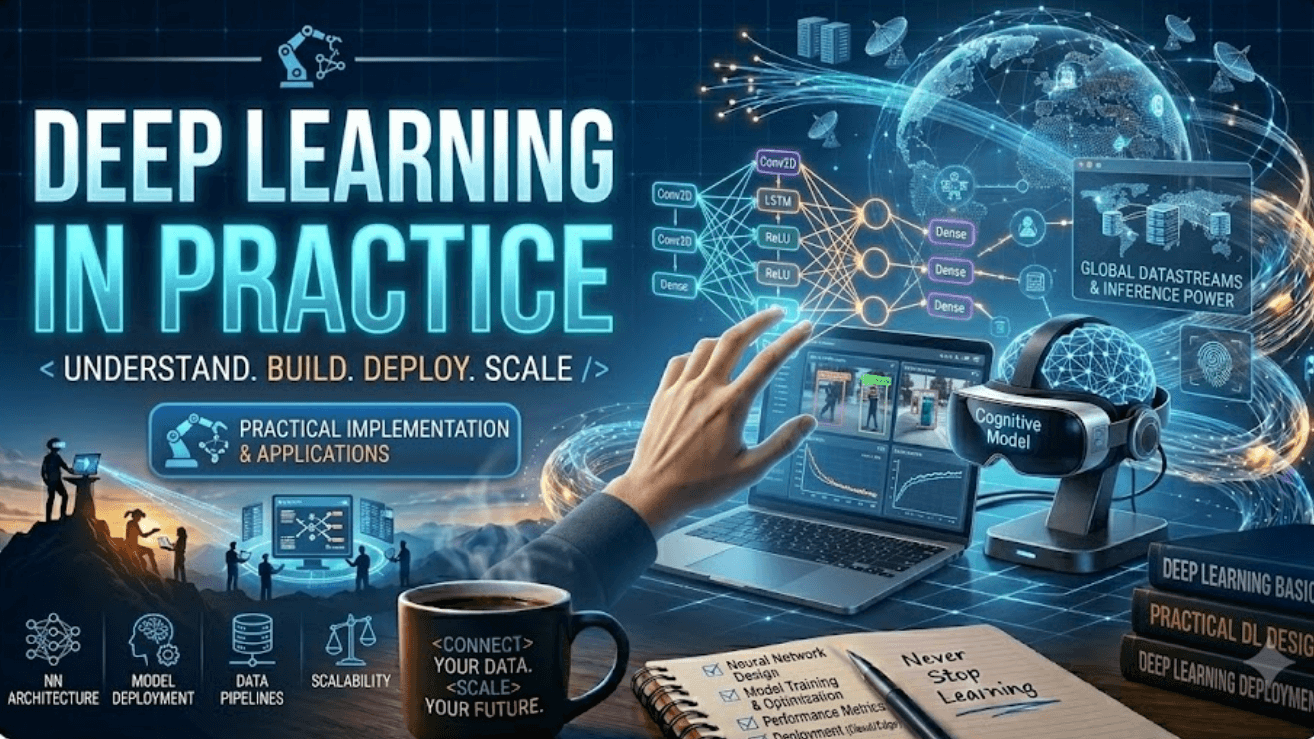
Welcome to Deep Learning in Practice, an intensive, hands-on journey designed to bridge the gap between theoretical machine learning and real-world AI deployment. This course bypasses the abstract equations to focus heavily on building, training, and optimizing production-grade neural networks. Throughout the curriculum, you will dive straight into industry-standard frameworks like PyTorch and TensorFlow. You will master the core architectures driving today’s technological revolution, including Convolutional Neural Networks (CNNs) for computer vision, Recurrent Neural Networks (RNNs) and Transformers for Natural Language Processing (NLP), and Generative Adversarial Networks (GANs). Moving beyond model code, this course emphasizes the entire engineering lifecycle. You will learn critical practical skills: handling messy real-world datasets, implementing effective data augmentation, debugging training anomalies like vanishing gradients, and leveraging transfer learning to build powerfu
Learning objectives
You should have a basic understanding of Python programming and familiarity with core machine learning concepts (like regression, classification, and train/test splits). A foundational comfort with high school-level linear algebra and calculus is helpful, but we focus heavily on practical implementation rather than deep mathematical proofs.
The course officially supports and utilizes both PyTorch and TensorFlow/Keras. Most production-grade hands-on projects will be built using PyTorch, as it is currently the industry standard for AI research and modern commercial deployment.
Do I need a powerful computer with a GPU to take this course? No, a high-end local GPU is not required. We will guide you on how to use free, cloud-based environments such as Google Colab and Kaggle Notebooks, which provide complimentary access to powerful GPUs directly through your web browser.
While traditional courses focus heavily on the mathematical derivations behind neural networks, this course is engineering-first. You will spend your time handling messy real-world datasets, debugging training issues, leveraging transfer learning, and deploying models to the cloud using MLOps best practices.
Will I build a portfolio by the end of this course? Yes, absolutely. The course features multiple hands-on projects covering computer vision, natural language processing, and model deployment. By the end of the curriculum, you will have a fully functioning GitHub portfolio demonstrating your ability to solve real-world problems using deep learning.